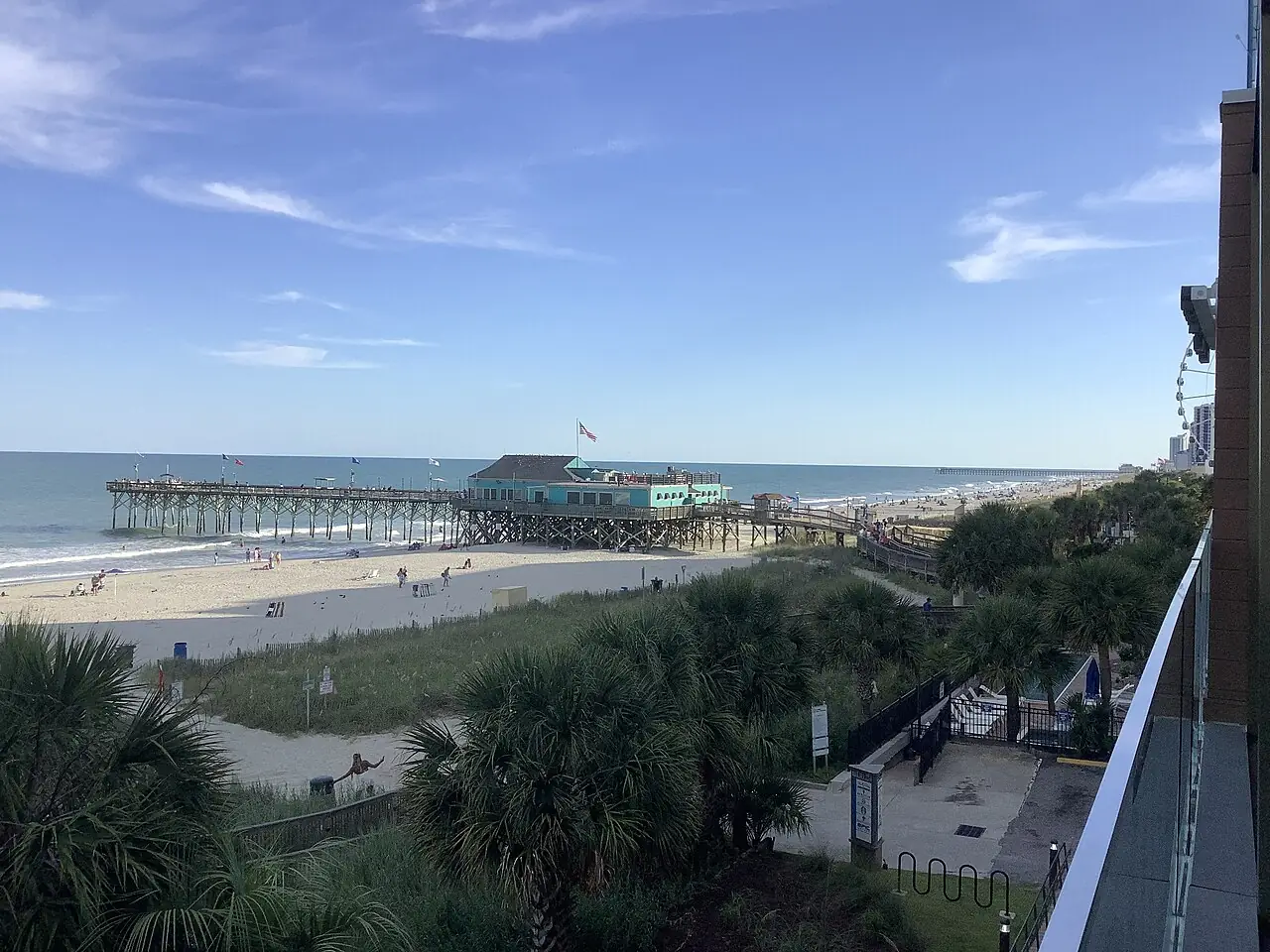
Buying a Short-Term Rental in Myrtle Beach, SC: Zoning, Taxes, Numbers & Condo Financing
The Grand Strand is several jurisdictions, not one. The City of Myrtle Beach limits short-term rentals to specific zoning districts. North Myrtle Beach has no special short-term rental zoning or permit process beyond licensing. Surfside Beach allows them in two zones. Unincorporated Horry County has its own license and fees. Many oceanfront condos do not qualify for conventional financing. Here is what investors should check before making an offer.
Last reviewed: Nov 2026 · Educational information, not legal or tax advice.
Can you short-term rent in Myrtle Beach, SC?
It depends on the jurisdiction and, in the City of Myrtle Beach, the zoning district. In the city, rentals under 90 days are allowed only in the zones shown on the city's short-term rental zoning map. Districts beginning with R do not allow them, except RMV, so few single-family streets qualify. North Myrtle Beach has no special short-term rental zoning or permit process beyond business licensing. Surfside Beach allows them only in R3 and C3. Unincorporated Horry County, including Garden City Beach and Murrells Inlet, requires a county business license, and you should confirm zoning with the county. Everywhere, budget about 12–13% in lodging taxes and the 6% property-tax ratio.
Last reviewed: Nov 2026. Rules change. Confirm with the city, town, or county for the specific property before you buy.
Step 1: Which jurisdiction?
A "Myrtle Beach" mailing address can be in the City of Myrtle Beach, unincorporated Horry County, or another town. Garden City Beach and Murrells Inlet are unincorporated. Look up the parcel through Horry County Land Info or the county GIS application, and get the zoning district before you write an offer.
Source: Horry County Land Info · Horry County GIS
City of Myrtle Beach: zoning decides
- Definition: "short-term" means a rental of less than 90 days, according to both city and state law, as the city describes it.
- Where it is allowed: only the zones shaded on the city's short-term rental zoning map. Zoning districts that begin with R do not allow short-term rentals, except RMV (Residential Multifamily Visitor). A property that is not already in a zone that allows them cannot be converted to or approved for that use.
- Grandfathered houses: city-wide, only 24 houses in traditional residential zones are grandfathered. Do not rely on a seller's rental history. Get the city to confirm the address.
- Oceanfront short-term rental conversion overlay (Ordinance 2024-69, adopted Dec 2024): in the area between Kings Highway and the ocean, a building with more than two units that has been used as a hotel or short-term rental cannot be converted to rentals of 90 continuous days or more. It followed a 2024 moratorium on those conversions. An owner has challenged it in federal court. In Aug 2025 the court let several claims proceed without deciding the merits (MBSC Property South LLC v. City of Myrtle Beach, D.S.C. No. 4:25-cv-01475). The overlay limits long-term use. It does not open new areas to short-term rentals.
- Business license: all owners of rental property need a city business license. Renewals are due April 30. Renewals received or postmarked May 1 or later pay a 5% penalty per month or part of a month. Ask the Business License Division (843-918-1200) for the fee.
- Enforcement: violations are misdemeanors, with fines of up to $500 and/or 30 days per occurrence on conviction. Questions about a specific property: Planning and Zoning, 843-918-1050.
Source: City of Myrtle Beach Planning and Zoning · Business License Division · WMBF, Dec 10, 2024 · MBSC Property South LLC v. City of Myrtle Beach, order
North Myrtle Beach: licensing, not zoning
- The city says there is currently no special zoning or permit process required beyond standard licensing. HOA, POA, and development documents can still restrict rentals.
- A city business license is required for all short-term rentals, renewed every year. Keep the license information current.
- Short-term rentals must collect and remit rental accommodations tax to the city, county, and state, and follow trash, parking, noise, and occupancy ordinances.
- The city has held short-term rental workshops (Nov 2024 and Jan 2025) and information-gathering sessions (Jun and Sep 2025). Its page does not show an adopted short-term rental ordinance, but new rules are possible. Check the page before you buy.
- City Hall: 843-280-5555.
Source: City of North Myrtle Beach, Short-term Rentals · North Myrtle Beach rental property quick reference (PDF)
Surfside Beach: R3 and C3 only
- Transient (short-term) rentals, meaning rentals for less than a calendar month or 30 days, are permitted only in the R3 and C3 zoning districts. Confirm the parcel's zoning and the current code with the town.
- The town treats all real estate rentals as a business. You need a town business license. The town asks you to allow 7 to 10 days.
- Town taxes: 1% hospitality tax and 0.5% local accommodations tax, filed monthly with the town's Hospitality Office.
Source: Surfside Beach Ord. 20-913 (PDF) · Town business licensing · Hospitality and accommodations tax
Unincorporated Horry County
Garden City Beach, Murrells Inlet, and other unincorporated areas need a Horry County business license (843-915-5620). The county publishes a short-term rentals tax chart on that page. Ask Horry County Planning and Zoning whether the parcel's zoning allows short-term rentals before you buy. The hospitality fee is 3% of gross proceeds from transient accommodations outside city limits and 1.5% inside city limits. It applies to accommodations subject to state sales tax under S.C. Code section 12-36-920.
Source: Horry County Business License · Horry County Hospitality Fee
Lodging taxes (stays under 90 days)
The South Carolina Department of Revenue share is 5% state sales tax, 2% state accommodations tax, and local sales taxes the department administers. Myrtle Beach's share includes a tourism development tax. Confirm the current rate chart before you underwrite.
- City of Myrtle Beach: 10% collected through the Department of Revenue, plus Horry County's 1.5% hospitality fee, plus the city's 1% hospitality fee and 0.5% local accommodations tax. About 13%.
- North Myrtle Beach: 9% through the Department of Revenue, plus the county's 1.5% hospitality fee, plus 1.5% local accommodations. About 12%.
- Surfside Beach: 9% through the Department of Revenue, plus the county's 1.5% hospitality fee, plus 1% hospitality and 0.5% local accommodations. About 12%.
- Unincorporated Horry County: 9% through the Department of Revenue plus the county's 3% hospitality fee. About 12%.
- Airbnb says it collects the state taxes, the Department of Revenue local taxes, Horry County's local accommodations tax, and the Myrtle Beach, North Myrtle Beach, and Surfside Beach local accommodations taxes on bookings of 89 nights or fewer. Its list does not include Surfside Beach's 1% hospitality tax, and hosts remain responsible for anything it does not collect. For direct bookings you need a Department of Revenue retail license and local tax accounts. Airbnb applies these taxes to the listing price, including cleaning and guest fees.
Source: SCDOR ST-575 rate chart (rev. Feb 5, 2026) · Airbnb Help Center, South Carolina taxes
Property tax: 4% vs. 6%
- South Carolina assesses an owner-occupied legal residence at 4% and other residential property, including a rental or second home, at 6%. A legal residence rented 72 days or less in a calendar year can keep the 4% ratio (S.C. Code section 12-43-220(c)(2)(iv)).
- Underwrite a full-time short-term rental at 6%, and get the current millage for the specific parcel from the Horry County Auditor.
Source: SC Revenue Ruling #15-4
State law watch
Statewide bills on short-term rentals have been introduced in recent legislative sessions. Check the South Carolina Legislature for current status before you buy.
Source: SC Legislature
HOA and condo documents
Condo regimes and HOAs can set minimum stays, rental-program rules, check-in requirements, and fees. Have the master deed, bylaws, rules, and the HOA budget checked before you are under contract.
The numbers (ranges, not promises).
Home prices from the Coastal Carolinas Association of REALTORS®. ZIP-code medians include areas outside the city or town limits, and a median mixes every property type in the ZIP:
| Source | Area | Single-family median | Townhouse/condo median | Window |
|---|---|---|---|---|
| CCAR All Cities report (PDF) | Myrtle Beach (29572, 29577) | $530,000 | $207,000 | Year to date through Aug 2026 |
| CCAR All Cities report (PDF) | North Myrtle Beach (29582) | $569,716 | $310,000 | Year to date through Aug 2026 |
| CCAR All Cities report (PDF) | Surfside Beach (29575) | $420,000 | $175,000 | Year to date through Aug 2026 |
| CCAR Monthly Indicators, Sept 2026 (PDF) | CCAR market-wide, single month | $370,000 | $230,125 | Sept 2026 |
| Source | Active listings | Avg daily rate | Occupancy | Avg annual revenue |
|---|---|---|---|---|
| AirROI, Myrtle Beach | 8,698 | $257 | 36.3% | $25,807 (+7.8% year over year) |
| AirROI, North Myrtle Beach | 4,564 | $375 | 34.7% | $34,401 (+12.2% year over year) |
| AirROI, Surfside Beach | 551 | $419 | 36.9% | $42,902 (+7.1% year over year) |
| AirROI, Garden City Beach | 374 | — | — | $41,223 |
| AirROI, Murrells Inlet | 478 | — | — | $47,603 |
Ask for recent sales of the specific type you are considering. The AirROI rows are market-wide averages of gross revenue before expenses for the 12 months to Sept 2026, updated Oct 1, 2026. Garden City Beach and Murrells Inlet rows leave average daily rate and occupancy blank where the cited table did not report them.
By size (AirROI, median / average annual revenue)
- Myrtle Beach: 1 bedroom $17.0k / $20.7k; 2 bedroom $20.1k / $25.1k; 3 bedroom $31.7k / $37.1k; 4 bedroom $56.0k / $57.4k; 5 or more bedrooms $65.3k / $77.9k.
- North Myrtle Beach: 2 bedroom $14.9k / $20.7k; 3 bedroom $21.2k / $29.7k; 4 bedroom $36.4k / $47.8k; 5 or more bedrooms $70.0k / $86.9k.
- Surfside Beach: 3 bedroom $29.2k / $33.6k; 4 bedroom $57.3k / $73.3k; 5 or more bedrooms $54.8k / $74.3k.
The spread is wide. AirROI puts the median Myrtle Beach listing at about $2,530 in an active month, the top 25% at $4,330 or more, and the top 10% at $6,770 or more.
Seasonality is strong. July is the peak and January is the slowest month. Occupancy averages in the mid-30s across the year, so summer has to carry the budget.
Heavy, professional competition. Myrtle Beach has nearly 8,700 active listings, and about 52% are professionally managed (43% in North Myrtle Beach). Smaller condos compete directly with hotel inventory.
Condo math is different. A lower price comes with HOA dues, special-assessment risk, and often an on-site rental program's commission. Compare net, not gross.
Source: AirROI, Myrtle Beach
Flood, wind, and insurance
Much of the Grand Strand is in FEMA flood zones, and oceanfront property faces hurricane wind and storm-surge risk. For a house, get the flood zone, an elevation certificate if one is available, and wind, hail, and flood quotes. For a condo, review the master policy, the wind deductible, and any assessment history.
Financing a Myrtle Beach, SC STR.
Two common paths. Which one fits depends on how you plan to use the property and how you want to qualify.
DSCR (debt-service coverage ratio) loans: qualify on the property
- You qualify mainly on the property's expected rental income compared with its monthly housing payment (principal, interest, taxes, insurance, HOA), not on your W-2s or tax returns.
- No personal income documentation is typically required. Credit, reserves, and the property still matter.
- For short-term rentals, lenders typically use a market rent or STR income estimate, or the property's actual booking history. On the Grand Strand, budget the payment with the 6% property tax, HOA dues (oceanfront HOAs can be high and may include special assessments), and wind, hail, and flood insurance included.
- DSCR loans are business-purpose investment loans: generally for investors, often closed in an LLC, and not for a home you plan to live in.
- Expect a larger down payment than a primary-residence loan, and pricing that depends on credit, the DSCR ratio, and reserves.
Condo-hotels and non-warrantable condos
Many oceanfront Myrtle Beach towers operate like hotels: a front desk, daily or short-term rentals, on-site rental programs, and a name with "resort" in it. Fannie Mae will not buy loans on units in projects managed and operated as a hotel or motel, including projects that are primarily transient, offer hotel-type services such as registration, daily cleaning, and central key systems, have rental-pooling or revenue-sharing arrangements, or are marketed as a resort or investment opportunity. Litigation, critical repairs, high investor concentration, and single-entity ownership can also make a project ineligible.
What that means: conventional second-home and investment loans often are not available for these units. Financing usually comes from DSCR, non-warrantable condo, or portfolio programs, which can carry different down-payment, reserve, and pricing requirements. This page does not state those requirements.
Check early. Ask for the condo questionnaire, budget, reserve study, insurance declarations, and any litigation or special-assessment disclosures as soon as you are under contract. Unit size, kitchen type, and the rental-program contract matter.
A condo with an on-site rental program may also affect material participation, described in the tax section.
Source: Fannie Mae Selling Guide B4-2.1-03, Ineligible Projects
Conventional loans: second home vs. investment property
Second-home financing can come with better terms than investment financing, but it carries occupancy rules. You must use the home yourself for part of the year, and the lender's program guidelines can limit rental use. Don't call something a second home if it's really an investment property. That's mortgage fraud.
Conventional investment-property financing qualifies you on your personal income and debts, using full documentation. It can be a fit for W-2 or self-employed borrowers with strong income.
Living in Charlotte, the Upstate, or Columbia? The Grand Strand is a common second-home market, but the lender looks at distance, use, and the project. Ask before you assume which path applies.
Oceanfront condos: see the condo-hotel note above. Many units that work as short-term rentals do not qualify for conventional financing.
We'll compare the paths side by side with your own numbers.
Not sure which path fits? Start your Myrtle Beach STR plan and we'll compare DSCR, second-home, and investment options for your situation.
The tax angle.
The property
Land doesn't depreciate — only the building and its components do. 15–25% is typical; check your county assessor or appraisal.
The strategy
A cost segregation study typically moves 20–35% of an STR's building value into 5, 7, or 15-year property (furniture, flooring, appliances, landscaping). An engineering-based study gives the exact number.
100% bonus depreciation applies to qualifying property acquired (binding contract) after Jan 19, 2025, and placed in service, under current federal law. Adjust if your CPA advises otherwise.
Your tax picture
Gross income before deductions. We apply the standard deduction and 2026 IRS brackets automatically.
100+ hrs/year, more than anyone else — required to offset W-2 income
Estimated federal tax savings (year one)
$21,991
real progressive bracket math, not a flat rate
Building value
$397,500
Reclassified
$99,375
Bonus depreciation deduction
$99,375
Top bracket reached
24%
Federal tax without strategy
$37,468
Federal tax with strategy
$15,478
Remember: this is a paper loss, not a cash outlay. The figure is federal only and reflects an effective 22.1% savings rate on the deduction. State savings would be on top where applicable. Recapture applies at sale, so this defers tax rather than erasing it. Doesn't account for NIIT, AMT, or QBI phase-outs. An engineering-based cost segregation study — not this estimate — is required to use these numbers on a return. This is not tax advice; consult your CPA.
Preset to a typical Myrtle Beach single-family purchase price (CCAR, year to date through Aug 2026). For a condo, try about $207,000. Change it to your actual price. The 25% land share is a single-family starting point you can change. Condo units often carry a smaller land share. A cost segregation specialist sets the real figure.
Cash to close vs. year-one tax savings (general terms)
Two numbers matter in year one: the cash you bring to closing (down payment, closing costs, reserves, furnishing) and the tax savings a cost segregation study and bonus depreciation might produce. For qualifying investors, year-one savings can offset a meaningful share of the cash invested. But the savings arrive when you file, not at closing, and only if you qualify. Your loan officer can give you an estimated cash-to-close figure, and your CPA can estimate the savings. Put the two side by side before you buy.
What a cost segregation study is
A cost segregation study is an engineering-based analysis, prepared by a cost segregation specialist, that splits the purchase price of a rental into land (not depreciable), the building (27.5- or 39-year property), and shorter-life components such as furnishings, appliances, fixtures, and site improvements (5-, 7-, and 15-year property). Moving cost into the shorter lives front-loads depreciation. It is usually ordered after you close, once the property is placed in service. For condos, the depreciable base is the unit's share of the building and its furnishings. A cost segregation specialist can tell you whether a study makes sense at a lower purchase price.
How the "STR loophole" works, in plain terms
The 7-day rule. Under the passive activity rules, a property where the average guest stay is 7 days or less is not treated as a "rental activity" (Treas. Reg. §1.469-1T(e)(3)(ii)(A); IRS Pub. 925). Myrtle Beach is a short-stay beach market, so many properties fall under 7 days, but winter monthly stays can raise your average. Your own booking data is what counts.
Material participation. For the losses to offset W-2 or other active income, you generally have to materially participate. Common tests are 100 or more hours and more than anyone else (including cleaners and managers), or 500 or more hours (26 CFR 1.469-5T). Many condos rent through an on-site rental program or full-service manager. About 52% of Myrtle Beach listings are professionally managed, per AirROI, which can make material participation very difficult. Keep a contemporaneous time log.
Cost segregation and bonus depreciation. Under the 2025 tax law (OBBBA), 5-, 7-, and 15-year property identified in a study can qualify for 100% bonus depreciation if it was acquired after January 19, 2025. Acquisition generally means the date of a written binding contract (IRS Notice 2026-11).
The excess business loss limit. Even when the losses are non-passive, the section 461(l) excess business loss limit caps how much net business loss can offset other income in one year. For 2026 the threshold is $256,000 ($512,000 married filing jointly). The excess carries forward as an NOL (Rev. Proc. 2025-32 §4.31).
Source: IRS Pub. 925 · 26 CFR 1.469-5T · IRS Notice 2026-11 · Rev. Proc. 2025-32 §4.31 · AirROI, Myrtle Beach
Watch-outs
- Depreciation recapture when you sell.
- Personal use of more than the greater of 14 days or 10% of rental days can limit deductions (IRS Pub. 527).
- State tax treatment can differ. South Carolina does not adopt federal bonus depreciation. IRC section 168(k) is listed as not adopted in S.C. Code section 12-6-50, so a South Carolina return uses a separate depreciation schedule. Ask your CPA how that affects you. Your home state may differ too.
- The NIIT, AMT, and QBI interactions are worth reviewing.
Source: IRS Pub. 527 · S.C. Code §12-6-50
Your STR Advantage team in Myrtle Beach, SC.
One point of contact for your Grand Strand STR financing.

Financing, BD Group
Brian DeFranco
Mortgage Loan Originator, NMLS #1600091 · BD Group powered by GoRascal, Inc., NMLS #2072896
DSCR, non-warrantable condo, conventional second-home, and investment-property financing for Grand Strand STR buyers.
FAQ
Start your Myrtle Beach STR plan
Tell us what you're looking for. We'll compare financing paths and, if you'd like, introduce an independent local agent and a cost segregation specialist.
DSCR/business-purpose loans may be available in other states, such as TN, where an individual MLO license is not required.
This is not a commitment to lend. All loans are subject to credit approval, underwriting, and property eligibility. Programs, rates, and terms are subject to change without notice.
BD Group is not affiliated with or acting on behalf of any government agency, and is not affiliated with the City of Myrtle Beach, the City of North Myrtle Beach, the Town of Surfside Beach, Horry County, Fannie Mae, or the South Carolina Department of Revenue.
Tax and legal information on this page is general and educational, not tax, legal, or investment advice. Consult a qualified CPA or attorney.
Revenue figures are third-party market estimates, not guarantees.
Short-term rental rules are summarized from public sources as of Nov 2026 and can change. Verify with the City of Myrtle Beach, North Myrtle Beach, Surfside Beach, or Horry County for your specific property.
 Equal Housing Opportunity